Thursday, February 27, 2025

Interlocking Walkthrough: WOOD

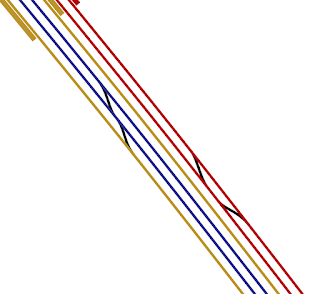
Up next for our Interlocking Walkthroughs is WOOD interlocking. It’s not that old anymore, but for a part of the railroad that has been around for so long, I expected it to be older. This interlocking first went into service on March 21, 1988, right around my birthday! As crazy as it may seam for an area so congested, WOOD only consists of three crossovers with two on the Port Washington Branch and one located on the Main Line.


Switches

WOOD interlocking covers the short span east in which the Port Washington and Main Line both run parallel each other. There are three crossovers. The Port Washington Branch’s crossovers, going from west to east, consist of a crossover from track 1 (the westbound track) to track 2. Not to far down the line, there’s another back from track 2.

The Mainline, however, only has one little crossover from Mainline 2 (the eastbound express track) to Mainline 4 (the eastbound local). This switch could be used for an eastbound that is bypassing Woodside but needs to make local stops in Forest Hills and Kew Gardens. However, normally I’ve noticed the LIRR will run trains stopping at Forest Hills and Kew Gardens down Mainline 4 in the first place, so these switches don’t get much use outside of a couple of peak trains.

Signals

For it’s 20th birthday present, in 2008, the LIRR gave WOOD Interlocking a nice little revamp. They installed high-speed switches which must have been the big present as high-speed switches are perfect for operations like what’s being performed on the Main Line. The signals used here are tri-color light signals arranged in a triangle pattern.

WOOD interlocking, like many Port Washington Branch interlockings, was controlled by HAROLD tower until it was closed in 1995. Nowadays, it’s remotely-controlled by Penn Station Control Center.

Neighbors

This interlocking is bordered to the west by HAROLD interlocking and is bordered to the east by JAY interlocking. Due to the LIRR typically running the majority of trains that are stopping at Kew Gardens and Forest Hills are routed down Mainline 4 in the first place, this switch isn't used too often. During rush hours, having trains slow for crossovers is nt the greatest thing when you have to operate so many trains so close together, and it's much more efficient and streamlined to not have to switch tracks.

Well, this should wrap up WOOD interlocking!

Wednesday, February 26, 2025

The Sunnyside Ordeal

In today’s post we’re going to take a look at the long-proposed Sunnyside station. Sunnyside station is a long-proposed station in the Sunnyside neighborhood of western Queens, the stations location is proposed to be very close to Sunnyside yard, with the actual location being at Queens Blvd and Skillman Av. The project, which, has been promised since 2001 would provide better transit options for residents of Western Queens.

Advocates for transit in western Queens had wanted this station for a long time, and it’s been promised for a long time, but, it hasn’t come. Then came the construction for East Side Access and the MTA claimed it would cause issues if they tried to build it during the construction of East Side Access. Then, fast-forward a long and grueling several years, and now we’re in 2025, and we still haven’t gotten any promises for the station.

A map part of the Sunnyside Master Plan

As you may or may not have picked up from my various posts overtime, I’m an advocate for better transit in Queens, especially in Eastern Queens, however I feel this area of western Queens is also underserved. A good argument for this station is that commutes on the Queens Blvd Line typically take 12-15 minutes while taking the LIRR could probably shorten it to 6 minutes. Another good argument is that both the Queens Blvd Line and the Flushing Line are very overcrowded, so, this would decrease the trip time. The project has been included in the MTA’s 20-Year Needs Assessment, so that really increases the likelihood of this coming. 

The station is proposed to consist of two side platforms and an island platform. They also claim it would be a connection point between LIRR and Metro-North (as part of Penn Station Access). Apparently there’s a possibility for Amtrak service, but to be honest little is known about the project right now.

If it’s true that you can easily go across the platform like you would at Babylon for a connection to Metro-North, that could be groundbreaking for Long Island - Upstate/CT commuting as it’s rather painful to have to get off the train at Grand Central Madison then walk all the way to the GCT concourse.

The current Sunnyside Yards as of 2025.

If this station ever comes to fruition, it’s likely that it’ll be built after Penn Station Access is completed. I also believe be similar to Woodside in that certain LIRR trains will make stops there. I’ve included it in my timetable project so for those of you that know about it make sure to look out for Sunnyside!

Sunday, February 16, 2025

Switch Heaters

In my opinion, one of the best ways to experience the LIRR is through snow. Not only is it beautiful, picturesque, but there's almost nothing better then looking over the edge of the platform at Jamaica on a cold, snowy morning and seeing the interlocking glowing. Wait, what? Why is the interlocking glowing?

When snow and ice tighten their grip, the LIRR will "fire up" dozens of heaters under the switches formally known as "switch heaters" to prevent the ice and slush from getting the best of the switches. These heaters play a silent, yet essential role in maintaining the rush hours. One disabled switch at let's say, Hicksville, for example, can cause one branch or even the entire rush hour to go down FAST! 

For a casual commuter, the site of a switch heater may look very alarming, however, it turns out that it's very normal for the switches to look like their on fire while the heater is on. 

Here are a couple of switch heaters at Jamaica in action (credit to NYC Subway Life):

Credit to NYC Subway Life

Credit to NYC Subway Life

Credit to NYC Subway Life


Credit to the MTA/Facebook


These days, many of the switch heaters on the LIRR are actually electric. They are made up of very high resistance metal bars that are bolted to both sides of the actual rail. One end is tied to the third rail through a knife switch, and the other is grounded to the rail.

Most of the switch heaters are activated onsite, while some are remote controlled. The gas-powered ones were much less reliable, and the gas was cheap. Today, they run using natural gas that is provided by the ulity companies and the gas is supplied to the heaters by a one-and-a-half inch pipe. Still, the gas heaters are unreliable. They can be blown out by wind, and then they have to be re-lit. Which, isn't exactly easy during a bad snowstorm or during the middle of rush hour.

Trackmen use "switch oil" to thaw out frozen switches. "Switch oil" is Hexane, which is a hydrocarbon oil that is dumped along the rail from a can that looks like a flower watering can. Another trackmen will follow with a brazing broom and soak up the stuff which then is used to light the switches, effectively de-icing the switch. 

The electric heaters are normally maintained by the signal department, while gas heaters by the Building and Bridges department.

While we're on the subject of ice and snow on the rails, let's talk about another common phenomenon that is seen.


I'll send the link to the video, but as you can see this NYC Subway train was making crackling noises as it was at 52 Street. Then as it began to depart, the contact shoe kinda lit on fire a bit and sparks came up. This is also a normal thing, as the snow, ice, and salt can cause it. 

In conclusion, switch heaters are a very imperative piece of railroad infrastucure that you should thank for getting to your job ontime during one of those snowy mornings that we all love. The concept of switch heaters has been around for hundreds of years, and it's evidence that many of the oldest pieces of railroad technology are some of the most reliable. Next time you see a switch on fire, please make sure to not call the fire department!

Saturday, February 15, 2025

LIRR & MNR to run on a weekend schedule on President’s Day

Monday is Presidents Day, and while it’s a holiday for some (including me), it’s also a working day for others. For those with employers that don’t give a hoot about presidents, the LIRR will be operating on a weekend schedule, and MNR will operate on a Saturday schedule. In many previous years, the LIRR has at least added one to three trains to the schedule , but this year those who commute are unlucky. I’m not too worried about loads, especially with the snowstorm coming, however, some of the Ronkonkoma and Babylon Branch trains may become crowded.


Friday, February 14, 2025

Late Friday Links 2/14

Happy Valentine’s Day! Here’s a couple of links for your commute home:

So there’s plans to introduce a new connection from the Ronkonkoma LIRR Station to MacArthur Airport. The plan is to build a walkway between the two, along with more parking and road improvements.

So apparently Metro-North also has a quiet car program, something I hadn’t actually ever realized. It’s disappointing to see it go since commuters seemingly really liked it.
And, finally, Metro-North has gotten a new president

The forecast is hinting towards more snow tomorrow, so make sure to bundle up. I’m lucky enough to have next week off from school. And remember, the LIRR will be operating on a full weekend service this Monday for Presidents Day. Have a good weekend! 

Interlocking Walkthrough: BABYLON

In today’s interlocking walkthrough we’ll be taking a look at the large BABYLON interlocking. Unlike many of the other interlockings we’ve looked at recently such as WANTAGH and AMITYVILLE, this interlocking is actually extremely busy.

Not only is BABYLON much more busy, but it’s also much bigger, too. In fact, it stretches 2 miles from end to end.

Switches

First, let’s focus on what’s west of the station platform. The first crossover that trains encounter when heading eastbound is a crossover right inside the interlocking that is going from the westbound track (Montauk 1) to the eastbound track (Montauk 2).

Then, after a couple hundred feet, The Central Branch merges onto Montauk 1 (Montauk trains that use the Mainline will branch off here in order to head towards Hicksville, Mineola, and Jamaica.)

After that, we have another crossover, with this one also going between Montauk 1 and Montauk 2.

Then, after going a bit further down the line, there’s another crossover this time going between Montauk 2 back to Montauk 1. Then there’s another one that does the exact same thing a couple hundred feet later.

Now, both tracks now approach the platforms. While Montauk 1 and Montauk 2 are curving to form the platform, a third track is created that also comes into Babylon smack in the middle. Montauk 1 splits into 2 tracks, with the north one becoming station track 1 and the center 1 becoming station track 2. Station track 1 is next to platform A, and station track 2 can open its doors on both platforms A and B.

Many electric trains that end their runs at Babylon will go east on Montauk 2, then continue onto Station track 3 to terminate before heading east towards the yard. Station track 1 is primarily used by trains that are starting at Babylon and just came from the yard. The middle track (station track 2) is typically used for Montauk branch scoot trains that will terminate at Babylon and then turn around, load, and head out east. This allows for a cross platform transfer for both sides. 

Now, once we get east of the station, things get much more complicated. First, there is a crossover (just east of the station) that goes from station track 3 to station track 2. Then station track 3 becomes known as the “LEAD track” (as it goes to the yard).

After that, there are a couple of crossovers that are used to get trains from the different station tracks over to LEAD so they can be yarded. First, there’s one from station track 3 to station track 2, followed by another back to station track 3. Then to add to the mix, a freight siding merges into station track 3.

Then, station track 3 passes thru the famous Babylon Car Wash. The Babylon Car Wash is kinda a big deal because there aren’t many car washes on the LIRR, with the only other locations being Ronkonkoma and Richmond Hill. Basically, all trains that are going to/from the yard will pass through the car wash to get all clean for their next run. But, for trains that aren’t afraid of the water or aren’t due for cleaning, they’ll go to/from the yard on station track 2, then crossover to LEAD just before the yard.

Now, we’re finally approaching the gigantic Babylon Yard. Compared to many of the LIRR’s yards, it’s quite big. It can store 17 trains, plus another if you use the LEAD track.

The yard is basically separated into 3 clusters of tracks. The first cluster, houses tracks 1 through 10, plus the LEAD and HOUSE tracks. There’s also two other clusters, yard tracks 11-14 and 15-17. Many of these tracks either combine or end in a bumper block at their very eastern end.

Another oddity of Babylon Yard is that the switches are automatically controlled, therefore allowing the employees to not have to hand-throw all of the switches themselves, and leaving the machines to do the dirty work for them.

Once you finally pass the yard, it goes back to the big three: Montauk 1, Montauk 2, and LEAD. These tracks go over Highbie lane crossing then proceed east a bit further before LEAD merges onto Montauk 1, before the final crossover from Montauk 1 to Montauk 2 commences signaling the end of the interlocking. It’s worth nothing that just east of this, third rail ends.

Signals

The signals at BABYLON are all old-style Pensy Postion-Light signals. There’s a good combination of places with those round things on gantries overlooking the tracks, and others on pedestals.

Babylon is slated to get an overall at some point in the upcoming years. It’s likely they’ll repeat what they’ve done at many of the other interlockings, by replacing all the switches with new ones, and sadly ripping out the switch handles. So, instead of a big handle being thrown to switch your train on the right track, it’ll all be done simply by a click of the mouse.

Towers

BABYLON is lucky to still have an operating tower onsite. Babylon tower sits just east of Babylon station.

Photo Credit: Joe Gregory/Trains Are Fun

BABYLON tower controls all the signals at Y, PD, and SK interlockings, too.

Neighbors

BABYLON interlocking is neighbored by AMITYVILLE to the west and by Y interlocking (just E. of Sayville) to the east.

The central speed limit thru all of BABYLON interlocking is 60 mph, though trains switching tracks often go slower. Just to the west of the interlocking, the speed limit is upgraded to 80 mph for trains continuing along the Babylon Branch towards Jamaica. If the train is going along the Central Branch, the speed limit changes to 65 (which is the maximum in diesel territory).

This concludes BABYLON interlocking. If I missed anything, please leave a comment below and let me know.