Tuesday, June 17, 2025

Montauk or Mainline? Which is it?

If your a regular (or semi-regular) Montauk Branch rider such as myself, and you take through trains to Jamaica, or further west, then you may not be able to help wonder why they sometimes take one route and some take another. This is a unique feature of the Montauk Branch that, in disaster, gives it one line of defense against extensive delays that could occur on either of it's possible Montauk Branch route options, the rest of Montauk Branch itself, or the Central Branch/Main Line. In an event of a disaster, Montauk Branch trains get the little known advantage of being able to "advert disaster" by choosing the other and completely bypass the chaos. It's rare that in the LIRR is there a time where you can take two routes to get somewhere, and taking about the same amount of time, either way.

Passengers like me who travel on the Montauk Branch east of Babylon get not only 1 or two routes, but three routes that their train can take. Westbound trains can either diverge just west of Babylon onto the Central Branch, taking them up to the Main Line, allowing them to flow through communities such as Westbury, Mineola, New Hyde Park, and through the eastern layer of Queens before coming into Jamaica, or, they can travel along the South Shore flowing through all those flowing communites, at near 80, if they were to travel this way, once they get to Valley Stream, they get two options to get them to Jamaica as they can either take the Montauk Branch (via St.Albans), which is the route they typically take, or if there's some sort of service disruption, they can take the Atlantic Branch, getting them into Jamaica around the same time. This gives Montauk Branch riders a secret advantage that wouldn't be seen on the other branches, as if there was issues on the Main Line, the other two diesel branches would be suffocated, and meanwhile, we'd be able to sail through.

With only a couple of exceptions, almost every Montauk Branch train can travel via the Main Line or Montauk Branch. With the exceptions being westbound trains 35, 37, and 7, and the eastbound ones being 76 and 80, all other eastbound trains can easily take either line. While generally speaking the LIRR plans out which trains take which, and trains typically stick to that order, in an event of a service disruption, track work, or some other planned/unplanned event, these trains could take either line. This allows the LIRR to avoid having to substitute. in other ways by giving them two options to get to Jamaica. This also gives them much more rush hour capacity as this allows them to have two options to run trains and typically given the third track, the LIRR tends to run the rush hour trains via the Main Line as there's more capacity up there (the only exception to this is train #5 which typically takes the Main Line, most likely due to the higher concentration of trains on the Main Line at that time.) I complied a document showing the train number and which route these Montauk Branch trains are scheduled to take on a normal day.

Montauk Branch Train Routings

With things like a railroad, there's rarely as an always, but generally, these trains stick to these routes. Of the trains that deviate their scheduled routing, I'd say the most common one must be train 8 to Montauk, which of them, most commonly gets deviated as #8MTKXX and runs via the Montauk Branch. In terms of the train that most sticks to it's routing, that award almost definitely has to be given to the Cannonball, which has done a better job sticking to it's Main Line routing then some of the trains that stop on there in the first place! 

I didn't include weekend trains, as I can't access their routes on a weekday, but generally, more of them then not take the Main Line. Still, there's a decent selection that take the Montauk Branch and even more so then on weekdays. I've noticed that more of the Sunday Hamptons trains have been taking the Main Line as last year only #6015 really did, but I guess this year they changed that as they become more comfortable with the third track. If you really dive in, you'll notice a couple of patterns, such as these trains taking the Montauk Branch at night in almost every case. My best guess for this is because generally taking the Montauk Branch is the better choice, it's slightly faster, there's no grade crossings involved, etc, etc, but during the day, given the high velocity of local trains on the Babylon Branch, it's difficult to get these trains up to speed when they could sail down the Main Line 3rd track.


As far as distances go, if trains travel via the Montauk Branch, it takes them 27.3 miles, meanwhile by taking the Babylon Branch, your traveling 28.1 miles. Generally, since it's a slightly shorter distance, and the speed limit is higher for a longer portion on the Babylon Branch, trains taking the Montauk Branch can generally make the trip 3 or so minutes shorter. In my opinion, the Main Line is more prune to delays, as more trains run on it, and there's also the grade crossings to deal with on the Central Branch, but, the Babylon Branch, during rush hours, can be much more tightly packed then the Main Line, and if there's one delay, then the parade of trains behind it will be impacted instead of being able to sail by on the third track. There have been multiple times that when trains have taken the Main Line they've been caught up with some short of shenanigans on the Main Line when if they took the Babylon Branch it wouldn't of been an issue, but, oh well. 

Montauk is typically the preferred routing, but the LIRR tends to gravitate towards the Main Line and I don't think there's truly a better option, I think it depends on certain circumstances such as how many trains are running and if there's any congestion or not. 

Monday, June 16, 2025

Massapequa Pocket Track

In today's post, we'll take a look at one of the most vital pieces of infrastructure on one of the LIRR's busiest lines- the Massapequa Pocket Track. Following the start of the Massapequa Station Rehabilitation project, the LIRR also began a project to build a 12-car "pocket track" just east of the Massapequa Station. In railroad terms, a pocket track is basically a storage track where trains can short-turn, so that they can more easily run trains that start mid-branch. 

This project was one of the many projects the MTA misjudged how long it would take to complete, therefore, it came out 4 years late. But hey, in my opinion, for a "megaproject" like this that only required total of three switches, five signals, and 1,000 feet of track, 4 years late can't be too bad! It ended up taking 8 years and over $19.6 million to complete. The project was constantly disregarded as construction for ESA was prioritized, making it difficult to get it done.

 (Photo: The LIRR Today)

Since the 1970s, the LIRR has operated "zone service" on the electrified portion of the South Shore. This broke the south shore up into four "zones".

  • Babylon, Lindenhurst, Copiague and Amityville
  • Massapequa Park, Massapequa, and Seaford
  • Wantagh, Bellmore, and Merrick
  • Freeport, Baldwin, and Rockville Centre.
Generally, during peak periods, express trains would make stops in one or two of these zones (ex. an express train making Babylon, Lindenhurst, Copiague, Amityville then stopping at Wantagh, Bellmore, and Merrick before going to Jamaica). And, during the peak of the peak where service is needed most frequently, many of these trains would run express after there intial zone (ex. the old #1013, which was the 7:11am out of Massapequa Park making Massapequa and Seaford only.) 

Since all four of these station groups had similar ridership levels, it made it very easy to provide a reliable skip-stop service and this made it easy to provide reliable service to everyone while still providing an assortment of express runs to all customers along the different segments along the branch.

However, there was one problem that made it a pain to short-turn trains, no place to store them. Given that there was no "pocket track" on the line, and only a pair of crossovers just east of the terminal of the line plus an extra set between Rockville Centre and Baldwin, it  made it a real pain to turn them, and unless they wanted to turn them on the Main tracks which is something they rarely did as it held up the entire line, this meant that they had to run all the Babylon zones trains all the way to Babylon Yard to turn them, and this meant for it being even more difficult to run trains during rush hours. Besides two trains (the old 1001 out of Massapequa Park and the old 1021 out of Wantagh), which both turned on crossovers along the branch. The only other exceptions to this were Freeport, which has a little yard, but under the current schedule, most trains don't start there anyway.

While it may not seam to bad to run an extra 10-15 minutes to the yard facility, during rush hours when equipment is constrained, that may make the difference between being able to make a second useful run back into the city or from the city or not, and either way, it is much better use of crew resources then to have them be paid an extra 20 minutes to deadhead to Babylon. In addition, during service disruptions that impact the line east of Wantagh, without the pocket track, rush hour operations as a whole would be jeopardized. By feeding the entire South Shore from one yard, it creates the potential for backups and congestion at the station, something that could impact revenue service as well as equipment trains.

However, with the elimination of zone service on the branch, this simplified service patterns to include two portions during rush hours:
  • Rockville Centre, Baldwin, Freeport, Merrick, Bellmore, and Wantagh
  • Wantagh, Seaford, Massapequa Park, Massapequa, Amityville, Copiague, Lindenhurst, and Babylon 
And while this was good in some ways, and offered good load distribution during a good portion of the rush hour, I don't totally agree with zoning it this way for the entire rush hour,  but that's a topic for another post.  

See how tracks are platform-length apart? 
While if I were running the railroad, I would've personally chose Wantagh as it's the actual startpoint of most of the trains that use the pocket track, I do see why the LIRR chose Massapequa instead given that the tracks were platform-width apart, making it easily the most convenient as they can basically just "stick" the new track in there. It also does allow the LIRR more flexibility in where it can start trains, and since ridership tends to build up west of this point, it is a great place to start some off-peak trains, like the ones seen headed towards/from Grand Central on  weekends, and since the trip is only 6 minutes I think between the pocket track and Wantagh, it doesn't add too much time.

Great photo of the pocket track by The LIRR Today

You may think that pretty much every LIRR train that ends in Merrick, Wantagh, or Massapequa uses the pocket track, however that's actually not the case, as there's actually more than enough instances where this isn't the case. You'd be pretty surprised to hear that of the Babylon zone trains, in the morning, only 6 out of the 10 of them turn off the Massapequa Pocket Track, and things really aren't much better in the evening as only 

As you can see, another disappointing aspect of these ESA timetables have been the lack of reverse-peak opportunities on the South Shore. One advantage of a pocket track is the reverse-peak potential. In Babylon, many of the trains there have been stored there overnight, therefore, they aren't running in the reverse-peak direction, but, since any train that turns on the pocket track must come from somewhere west, it adds the potential to provide steady reverse-peak service, allowing for improvements, especially earlier in the rush hour.

In my opinion, Massapequa is a perfect place to turn reverse-peak trains, as it ends the main portion of reverse-peak travel along the branch. It's really not that difficult, on a two track branch, to run a train that is already running anyway add a couple of stops to it. And, they don't even have to run it local; they can have it pick up a couple of stops with another train making a couple more to speed up it's travel time, and this could even allow some of the reverse-peak Babylon-bound trains to skip some of these stops, speeding up travel times for those going to the more eastern zone.

While the service plan did offer a modest increase overall in reverse-peak service, for the busiest line, there is still lot's of improvements that can be seen, and I think this pocket track has much more potential with reverse-peak service.

In conclusion, while I think the Massapequa Pocket Track offers a lot of benefits, the LIRR needs to step up and provide even more robust peak service and a better more reliable line of reverse-peak trains to serve the riders growing needs on the busiest portion of the busiest branch of North America's busiest commuter railroad the Long Island Rail Road.

Wednesday, June 11, 2025

Interlocking Walkthrough: QUEENS

In this interlocking walkthrough, we will once again take a look at a busy interlocking located near Jamaica Station. This one is the long and extensive QUEENS interlocking, which, spans the entire length of 3 stations. Not only is it a rather large and complex interlocking, but it's also important as it marks the start of four-track territory on the Main Line, upgraded from 3 east of Floral Park.

QUEENS Interlocking hops over the border between Queens and Nassau County, where it switches right before Elmont station. As you can see in the diagram below, QUEENS interlocking is massive, spanning just under a mile long. This shows the impressive length between stations in this area with them being under .3 miles apart each.

While I can't find a diagram of QUEENS, and I don't have time to make one (it's finals week for me and I got a lot going on), here's a birds-eye view of the peak of it just before Elmont. If you’d like to see the rest, I recommend pulling it up in Google Earth and you can use it as a reference as we go through the interlocking.


Before we begin the interlocking tour, it's very important to note that techinally, two routes pass through the interlocking. The Main Line (trains coming onto or off of the three-track Main Line out towards Hicksville), and the Hempstead Branch (trains merging onto or merging of off the Main Line at Floral Park coming from/towards Hempstead).

We'll begin by looking at the Main Line, heading eastbound. As said previously, the interlocking begins just east of Queens Village.

Switches

Let’s start at the eastern end of QUEENS interlocking, and we’ll start by looking at the Main Line considering that’s the route that the majority of the trains run on. The interlocking begins just west of Floral Park, and there aren’t any switches (on the Main Line portion) until a bit west of Bellerose, where there’s a crossover from Mainline 3 over to Mainline 1, then another one shortly afterwards back to Mainline 3. The goal of those crossovers is to take a train onto or off of the third track. They do this during the morning rush hour for some of those New Hyde Park locals that have to run express after there towards Jamaica, they use the first switch mentioned to get onto the third track and bypass Elmont and the other eastern Queens stations. The second switch allows trains that were routed down the 3rd track to stop at Elmont.

So, at this point, we’ve now reached the Elmont platform. We now pass through Elmont, and soon after we leave Elmont, we encounter a series of four switches, each one timed perfectly after another, from Hempstead 1 all the way to Mainline 3. The goal of these switches, before Elmont opened was to bring westbound Hempstead branch trains from the westbound Hempstead Branch track all the way to the westbound Main Line track as to allow for Hempstead Branch trains to stop there. However, when Elmont opened, it basically became the new Queens Village and therefore, as you’ll see in a minute, this move was duplicated before Elmont. After those switches, there’s one final crossover from Mainline 1 to Mainline 3 before we platform at Queens Village.

Now, let’s take a look at the Hempstead Branch routings. Once the Hempstead Branch merges onto the Main Line, things continue normally through Floral Park, until we reach the western end of the platform where there’s a switch from Hempstead 2 (the eastbound track) to Hempstead 1 (the westbound track), before those tracks travel the short distance to Bellerose, and through it, once we get halfway to Elmont station, is where the first series of crossovers (from Hempstead 1 all the way to Mainline 3 that I discussed earlier starts. Finally, just west of Elmont, the Belmont Park Branch splits off heading towards it on the Hempstead 2 eastbound track. It then merges on again later as part of the other end of the spur a couple hundred feet to the west.

So there’s a little general overview of all the different pairs of routings through QUEENS.

Towers

Originally,  there was a QUEENS Tower, which controlled the operations of this busy interlocking, but it closed in 2020 and operations were switched over to JCC Interlocking in Jamaica.
Borders

The mighty QUEENS interlocking is bordered by HOLLIS or HALL interlockings to the west, depending on which track your positioned on it's bordered by NASSAU interlocking to the east if you are heading on the Main and by GARDEN if your routed on the Hempstead Branch. 

Anyways, I'm sorry this interlocking walkthrough was so weak and put together at the last minute, I wanted to get something out today but I've been very busy since it's the last full week of school before finals and it's been difficult to find time. I hope you enjoy this read while I'm getting an award at my awards ceremony!

Monday, June 09, 2025

Platform F, and it’s issues….

One of the worst elements of the modern LIRR has turned out to be the LIRR's revolutnary take on modern Brooklyn service. Platform F. As part of the Jamaica Capacity Improvements project, the LIRR created a new platform, in a way partly isolated from the rest, known as platform F, they then routed pretty much all the Brooklyn trains to use these platforms, running as a shuttle between Atlantic Terminal and Jamaica. The goal with this change was to eliminate crossover moves, and to segregate Brooklyn service in order to free up the Jamaica tracks for both city terminals. While officials called this an "improvement", the thing is, in reality few Brooklyn riders feel they can call it that. Eventually, the LIRR added a couple of thru-trains to Brooklyn, however, I feel very few of them are actually useful. The early trains out of Huntington and Babylon leave literally at the crack of dawn, before 5am, and while the Ronkonkoma train does leave a bit later, closer to 5:30, (and if you saw some of my Ronkonkoma branch posts you'll know there's a mini rush-hour at that time, even the Ronkonkoma Branch train is a bit early and many of the Brooklyn commuters are travelling later in the rush hour so the equipment for this train could be better used later, and at this point, if the LIRR has the logic to make the only thru Brooklyn service run at the least convient times, I think it's better off if they just run those trains to Manhattan. The LIRR has to have the mindset that they can still run thru-trains to Brooklyn, to supplement, and provide more options for Brooklyn and intra-island/city riders alike.

The problem is that platform F is designed in a way that makes it very difficult and beyond cumbersome to run trains beyond Jamaica, therefore, they had all Brooklyn trains end in Jamaica. And while they may try to say they beefed up service, it was actually a 20% reduction, and to make matters worse, before ESA, they were able to match service with capacity, therefore, during busier times, more trains were ran to match the amount of travelers, so capacity was matched. However, when platform F (and the new schedule opened), they ran roughly the same amount of trains during each of the hours, therefore, Brooklyn riders were plagued with overcrowding. Later, the LIRR realized this, and they reworked the schedule to add more trains to match a pre-pandemic headway. Since, in the last year or so, ridership has mostly stabilized and things have been working out. 

The cumbersome up and over...

Another issue with platform F that has continue to plague Brooklyn riders is the cumbersome up and over. Typically speaking, if your someone who's unlucky enough to make a transfer at Jamaica, all it is is an up and over one, two, or at worst, 3 platforms over, however, if your a Brooklyn rider, the LIRR has spared no expense at making you sprint every morning across the entire concourse over from platforms 1, 2, and 3 to platform F which is as far as you can get on the other side to arrive just in time to see your train leaving. Prior to East Side Access, typically all westbound trains would depart from platforms 1,2, and 3, therefore, you'd only have to climb a platform or two over in the mornings and afternoons to reach your connection, but now that most Brooklyn trains board from a platform on the opposite end of the concourse, people have to walk twice as much as they used to reach their connection. Thats another benefit of direct service that not only people on that branch will benefit from, instead everyone will as that gives a better chance of a cross-platform transfer, or at most a up-and-over.

Unfortunately, because of the platform F location, Westbound Brooklyn commuters are hit harder in the morning as the typical westbound tracks 1,2,3 are on the opposite side of Jamaica, therefore, commuters must walk the entire length of the concourse to get to the other side where the shuttle platform is. This often leads to missed connections.

Missed connections

The final key problem with platform F is the missed connections. With the LIRR's new policy of making zero-attempt at holding trains for transfers, when trains are on time, things work, but when trains run late, the system starts to fall apart, leaving riders fuming as doors shut in their faces. 

And while things have gotten somewhat better since the first months after East Side Access, this is still an issue with people having to wait because of it. It does seam however, that on many branches, the LIRR seams to have as many connections as possible for other trains be thru-trains, however, limiting the amount people have to do that up-and-over all the way across the concourse.
This is especially a problem in the evening rush hour as while in the morning if you miss your train the next one is typically in the next 8 minutes or so, but in the afternoon, you may be waiting 10,20,30, 45, or even 60 minutes for the next scheduled train, depending on the branch. This is a big problem and the LIRR needs to figure out a way to fix this so people aren't winging making their connection every day.

In all, it took all of this nonsense for the LIRR a while to realize how important Brooklyn really was, and to appreciate it enough to make changes by adding more thru-trains (and by no means enough, but hopefully at some point we'll get there!)

Sunday, June 08, 2025

2025 Ticket Sales Data

I think one of the most important pieces of data the LIRR can get is ridership patterns- it tells you where the most people are coming from and want to go so you can fine-tune your service to best meet everyone's needs. And while the data the LIRR gets (through the train-by-train ridership counts they refuse to give out for no good reason and the ticket sales data aren't perfect, they give a very good general idea of what the patterns look like).

I decided to anazlye the LIRR's ticket sales data, which I retrieved through a FOIL (Freedom of Law request). This data gives a general overview of ridership between two given stations, and when you put it all together it gives a general overview of the current ridership patterns.

I can't link the actual excel sheet I used to put together the tables, graphs due to it being too large, if you'd like to see that information, you can send me an email and I'll find a way to get it to you.

Station pairs

Shown on the top of the chart are the busiest station pairs in the system. Hicksville and Ronkonkoma tickets to NY-Penn Station continue to lead, however if intra-city travel continues to grow, I could see Hicksville being overtaken by Jamaica.

Surprisingly, this year, there were only two station pairs with over a million riders, mostly thanks to the effects of the pandemic. The average number of rides across all those were 4,356, and that’s about how many rides was taken between Port Jefferson and Stony Brook. Out of the pairs ticketed, Riverhead-Merllion Avenue and Yaphank-New Hyde Padk were ranked lowest at only one ticket. Not surprising.

Highest intra-island pairs

This included ticket-pairs that were to/from two stations that aren't city terminals (NYK, GCT, KGN, FHL, WDD, HPA, LIC, JAM, NAV, ENY, ATL). 

The top of the chart was almost entirely dominated by intra-island travel among Port Washington Branch stations, and that's a good thing considering it's easy to add intra-island stops on the two-tracked Port Washington Branch! For the most part, the rest of them were rather expected.

I was planning on including more information and information about the ticket types, however, this post took a long time to make since I had to plug all the information in to make the charts, compile the information, not to mention I'm still waiting for the FOIL request to comeback, therefore it would be much harder to compile the rest of the information, therefore, I decided to just skip out on the rest, this post took much longer than it was supposed to make, but I think this gives you a good idea of how things are going.

Friday, June 06, 2025

Interlocking Walkthrough: HALL

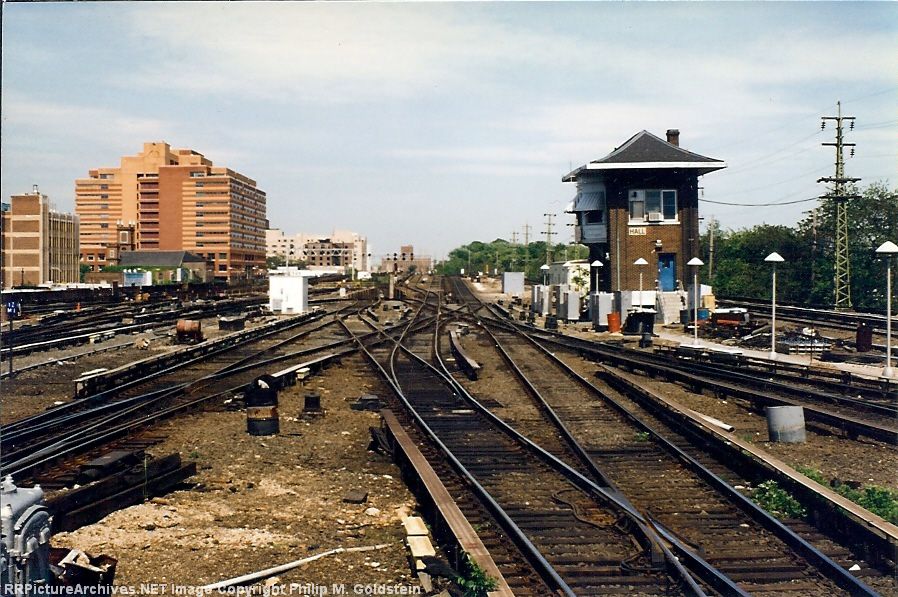
Today, we're going to be taking a look at one of the LIRR's biggest interlockings- HALL interlocking. HALL Interlocking can only be competed by it's sister interlocking, JAY interlocking, which controls the part of Jamaica where trains are coming from in the west, therefore, complementary to it, this interlocking controls trains coming into Jamaica station from points east.

While I like to say all 3 Jamaica interlockings- HALL, DUNTON, and JAY are important, I like to think that JAY and HALL are the more important ones, as they are busier, and as DUNTON is also off to the side a bit only controlling a much lesser portion of trains on the Atlantic Branch. The busier JAY interlocking will be featured in a post in a couple of weeks.

HALL Interlocking is so large that I think it's almost impossible to explain it and it would be quite a long post if I attempted to, therefore, I'm going to try my best to sum it up and explain it from there. I'll give you the "gist", and once you get the "gist", you should be able to figure out the rest of the interlocking from there. 

However, thanks to a very handy-dandy NYC subway trackmap, you'll be able to see what HALL looks like in detail:


As you can see, HALL's borders extend from where the Babylon Branch (uhm, excuse me, Montauk Branch) join in to the last switch before Jamaica station begins going westbound.

While I think that diagram makes this interlocking look much simpler, I still believe it can be very confusing to grasp, at least at first.

You'll notice how the tracks of both the Atlantic Branch (shown below), and the Montauk Branch have to try to get off of HALL interlocking so they can head towards the South Shore, therefore, they duck under the interlocking in order to get away from it. 

Here's another photo that more clearly shows it:


You'll notice that the same thing happens a bit later on into the interlocking with the Montauk Branch heading off, however, when it's their time to leave the Main Line, they rise all the way up and go over the eastbound tracks, oppose to under like is seen with the Atlantic Branch. 

Now, go into Google Earth and take a look at the interlocking, and also note that the Atlantic Branch tracks leave from the middle, however, you'll notice that the Montauk Branch tracks leave from the center, too. All of this was done specifcally with the intent of streamlining the interlocking, allowing eastbound and westbounds to stay apart from each other the entire way, in this way, this allows the LIRR to operate this massive amount of trains through the interlocking.

In addition, with the way it was separated, a dispatcher wouldn't have to wait for an eastbound Montauk Branch train to go before a westbound Main Line train could go, even further simplifying operations. I feel that the way they made this interlocking made it geniously-designed to handle all the immense train-traffic it has to manage, the way they had the 2 branches leave the Main Line without disrupting the flow of the other Main Line traffic is just genius and probably took a lot of work to get right.

I tried to simply this interlocking walkthrough, considering the immense complexity of the actual interlocking, and if it doesn't make sense, trust me, once you read the JAM interlocking walkthrough, when it comes out, it'll all come together. Trust.

Tuesday, June 03, 2025

Interlocking Walkthrough: HUNT

Since the upcoming release of the reworked Port Jefferson Branch timetable, I decided to visit HUNT interlocking (located in Huntington), for this interlocking walkthrough. This interlocking is split into three parts. It would be difficult to insert photos of all 3 interlockings, so, instead here's a bird's eye view of the location.

HUNT Interlocking has been around for some time, being opened on June 26, 1976. Orginally, the three interlockings actually had different names. HUNT 1 was referred to as BURKE, HUNT 2 as HUNT, and HUNT 3 as COREY. However, some years back, they combined them (similar to what happened at FOX) to form the what is now known as HUNT interlocking.

Switches

HUNT 1 

When approaching from the west, a westbound train would first encounter HUNT 1. Firstly,  there's a crossover from Port Jefferson 2 to Port Jefferson 1. Shortly then after, the North Side Track splits off.

The North Side Track is where the LIRR stores it's diesel fleet in service for the Port Jefferson scoot. When a westbound shuttle comes in, it'll unload passengers then come onto this siding to wait for it's eastbound action.

Then there's a 6-way grade crossing, before the interlocking officially ends.

You thought we're done????? Hell no. We're just getting started. Just after the eastern limit of HUNT 1, the two team tracks split off and run north. There's also a run-around track, similar to what would be seen at interlockings like DIVIDE.

Now we're onto HUNT 2, which, begins just east of the station. It's pretty much a reversed carbon-copy of HUNT 1. It starts out with the North Side Track merging back into Port Jefferson 1, followed by a crossover over to Port Jefferson 2. HUNT 2 then ends shortly before the actual station platforms.

HUNT 2

HUNT 3 is next, and this is the last of the three. This is east of the station, and there's a pair of crossovers from Port Jefferson 2 to 1 then back to 2. These are well used crossovers, as diesels from Port Jeff on platform B and all electric trains must use this switch.

HUNT 3

Signals

HUNT interlocking has the typical Pensy-style position-light signals seen at many interlockings still across the railroad. 

Towers

HUNT never had a tower, and all operations were controlled via DIVIDE interlocking.

Neighbors

HUNT is neighbored by AMOTT interlocking to the west (between Cold Spring and Syosset, and by DUKE interlocking (in Northport) to the east. There's a passing siding in Greenlawn, however it is hand-thrown, therefore, it doesn't really count as an interlocking.