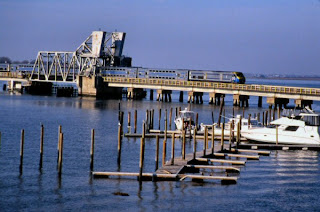
Showing posts with label Long Beach Branch. Show all posts

Sunday, March 22, 2026

LIRR schedule changes start tomorrow morning

The LIRR is making it's normal spring schedule change, and they are adding a couple of stops to trains.

This isn't a big schedule change; and there are only a couple of small changes to be aware of on the timetable, mainly during the late evening:

  • The 10:20pm train from Penn Station to Huntington will make an added stop at Floral Park
  • The 6:48pm train from Long Beach to Penn Station will make an added stop at Rosedale.
  • The 3:17pm train from Penn Station to Babylon will make an added stop at Baldwin.
And while these changes are at best underwhelming, considering all of the changes that could be made, I do appreciate the LIRR looking at the schedule to see what small changes they can make to improve service based off ridership patterns and I definitely feel that these small changes will benefit some. 

Thursday, June 19, 2025

Addressing the LIRR's summer beach services, especially off the South Fork

Through this year's summer schedule changes, the LIRR continues the trend of bringing little to feed summer ridership, something which has been growing rapidly in the last several years.

When they opened East Side Access, instead of looking for ways to improve off-peak travel options for the average traveler they continued to provide the same old hourly headways on the "minor" branches. Instead of looking to improve the single most growing area of ridership on the railroad, they instead continued to overlook the diesel branches, and not try to find ways to rework the schedule to benefit more commuters and leisure travelers alike.

If you've been a regular reader of the site, then you'll know that I talk a lot about summer service on the South Fork and all the improvements that can be made. And while I'll be honest and say the LIRR does provide a pretty good selection on the South Fork, there's still a lot that can be done with existing equipment to help with the extreme South Fork crowding. However, in today's post, I want to focus on the LIRR's disapointing summer service, specifically out on the North Fork and Long Beach, areas that both can see much more improvement then what can be seen on the South Fork, but continued to be pretty much ignored outright. In a future post, I'll be detailing exactly what improvements can be made to summer service on the South Fork, as well.

Long Beach

One of the more aggravating parts that have been continued in this year's summer schedules is summer service on the Long Beach Branch. 

This year, they once again changed the departure times of westbound Long Beach Branch trains on weekends, this time they changed it to :38 past the hour. Then, they made the move to have the only westbound express train to serve Long Beach depart at 4:28pm, which makes no sense since there's only a 10 minute gap between trains.

And, to be honest, this is one area the LIRR can actually do a lot to improve. Summer conditions on the Montauk Branch are kinda set in stone until the LIRR receives more equipment, and while I don't mean they can't make any improvements, it's very limited in what they can do. However, the same can't be said with the Long Beach Branch as there's a surplus of electric equipment that just sits around in yards on weekends, and during the middays when people are most traveling to the beach.

 Example of seasonal Long Beach service
And Long Beach ridership is really at the point where it could sustain half-hourly service. Far Rockaway Branch ridership is roughly half of what Long Beach sees, yet it receives the same plain-old hourly service. It’s almost at the point where the Long Beach Branch could warrant an upgrade to half-hourly service, at least during the summer months and during the winter for winter shopping from May to September. To be honest, the LIRR really should think of investinf

The LIRR likes to use the excuse that they can’t provide any more trains into Penn Station, forgetting that they just built an over $11 billion dollar new terminal, also located in the heart of Manhattan. While Grand Central may not be located in downtown, it's still a busy area and I'm pretty sure with all those subway and bus connections it would be well-used. 

I’ve heard many people who’d prefer to use Grand Central in order to get out to the beach, and I think it could be a popular service in both directions. I think hourly Long Beach-GCT trains during the peak direction on summer weekends could actually be a decently popular service and they could try that for a summer. They have enough equipment to do it, why not give it a try?

North Fork

Similarly overlooked, the new schedules continue bring very little to the North Fork. Stuck with the long forgotten and overlooked scoot, the non-electrified Main Line receives less service than it did 40 years ago. While I can't blame the railroad for not adding too many more trains, considering they have failed to install PTC, therefore, they have to run very limited schedules on it, I do blame them for getting out of installing PTC in the first place and I believe they can still make some improvements to at least make this branch "workable" until further improvements can be made along the branch.

In it's current state, this line literally has no potential to grow. Stuck with one lousy AM peak train, that departs Greenport before even the rooster wakes up at 5:21am, running even earlier than the first peak train from Montauk, and it's already a bad start considering if they shift this train back another 25 minutes or so, it'll be of at least some use to people, getting into Penn slightly later. 

In order to make use of the little equipment and space we have, I believe after arriving at Ronkonkoma, it should immediately turn around and head out to Yaphank, and then represent another peak run back to Ronkonkoma, to at least provide a later option for people. It would then head out, once again, a bit later, as the normal morning train to Greenport. This will make the early train to Greenport a bit later, hopefully of slightly more use to summer travelers. While none of this is ideal, until we install PTC, get more equipment, this will at least make use of the little infrastructure we have. We should also convert the early, early morning equipment train out to Greenport to revenue service, as while I believe few would use it, it would be a zero-cost improvement and we should not ever be deadheading on this line, zero excuses, and hey, it could be considered a fisherman's train. Who knows!

And not to mention that if you want to spend a daytrip out in Greenport on a weekday, the options are extremely limited. You could either take a 5:40am out of Penn, and connect with the 7:25am out of Greenport, getting you there around 9am. And while I'm not doubting that train is useful for certain reverse-peak customers, with the limited equipment we have, it should be geared more towards summer crowds on weekdays and it should be really shifted back about an hour and a half in order to provide a better option. And while it would deny an early reverse-peak option, reverse-peak travel out there is so limited anyway that it would do much more good than it would do harm to run it later. 


I was planning on taking a daytrip out to Greenport today, Juneteenth, but since the options are so limited with a 7:25am departure out of Ronkonkoma, which is way to early! I'm just going to go this weekend instead since there's more options. It sometimes feels like the LIRR is almost sabotaging summer service altogether on this branch.

(Photo: MTA)

I mean look it's getting to the point where it was easier to get to/from Greenport 62 years ago then it is now. And if in railroad, service now is worse than 62 years ago, then that should mean there's a huge problem. Take a look at how service was provided in the 1980s and compare it to today, service then was much better structured and convenient, and that's with true busses to supplement it! 

Summer Fridays

Continuing the trend that they've done for years, the LIRR continues to provide a second eastbound train to Greenport on Friday afternoons in the summer (extending the train that would otherwise turn at Riverhead), and use that opportunity to swap out the equipment. When the second eastbound train gets out there, the crews swap equipment with the old set going back to Jamaica Storage Yard to be refueled, serviced, while the new set begins it's run on the Scoot. 

(Photo: The LIRR Today)

There's nothing wrong with that. However, the LIRR runs that second set of equipment all the way from Jamaica Storage Yard to Ronkonkoma, empty. The LIRR could easily take this opportunity to provide an express run out to Greenport, for zero cost, and not only would this for the first time in years provide a direct express train out to the North Fork, but it would also most likely take some load off the Ronkonkoma Branch, which it's trains are quite busy on Fridays at this time of day. 

The truth is... they should've done that years ago when they first ran that second equipment out but instead they continued to do it this way. Of all the times they could provide a direct ride out there, this is one of the best and most popular times of the week to provide time savings to these travelers. 

I mean look, I think we can all agree Montauk is better, but how come Montauk gets hourly service out to there, yet, Greenport, on the other hand, doesn't even a direct train, when it could using already available equipment. 

With a branch like this that has so little service opportunities, the LIRR should jump at any idea to improve service, especially at no-cost to riders. This would give people a faster ride and would take stress of busy Ronkonkoma trains on summer Fridays, and would at least make it look like they tried to improve service.

Now, I will be showing off what I believe the LIRR can do with the North Fork more long-term in a future post, but, for now, I think there's a lot the LIRR can do to improve service just a bit.

Thursday, May 29, 2025

Interlocking Walkthrough: LEAD

In this interlocking walkthrough, ooof, it's been a while, we're taken across the bay to the beautiful enclave of Long Beach, home to one of the most interesting interlockings the railroad has to offer.

Diesel equipment over LEAD 
Shortly after departing Island Park, the line merges into one track before shortly passing over the LEAD drawbridge, which is over the Reynolds Channel. 

Switches

Today's post, however, will focus on the tracks themselves. The interlocking begins just east of the Long Beach grade crossing, where track 2 merges into track 1 to head east. As soon as the tracks merge, the speed limit drops to 30 mph. 

The speed limits into Long Beach are quite brutal, as southbound trains get knocked down a cab aspect signal or two because these trains are terminating, and southbound trains typically get knocked down to 15 on the bridge, and to the even worse 5 mph for the final stretch into the station. Northbound trains, are lucky enough to go on the bridge going 30.

Closeup of the drawbridge

Signals

LEAD consists of your typical Pensy-style position-light signals. 

Towers

LEAD is home to one of the LIRR's only remaining towers! LEAD Tower is a dark brick structure, seen to the side of the drawbridge. LEAD Tower exists due to the drawbridge. While they could possibly control the interlocking via Jamaica, the LIRR likes to play it safe considering when it comes to moveable bridges, it's better to have a human on site making sure there's no technical difficulties because if something malfunctioned, things would not be good.

Well, that should conclude LEAD's Interlocking Walkthrough. For those of you that follow the blog (If you do, I highly appreciate it), tomorrow will be looking futher into the LIRR's beach services (including the Long Beach Branch).

Wednesday, May 07, 2025

What The Long Beach Branch Timetable Could Look Like

Our last post focused on the Ronkonkoma Branch and now we're going to move on and take a look at a revamped Long Beach Branch Timetable. The Long Beach Branch is a rather short branch, with only a limited couple of stops, however, it sees a fair amount of riders, especially from it's eastern terminal in the city of Long Beach.

Included in the linked PDF file below is the Full Sample Weekday and Weekend Long Beach Branch timetable. Peak, off-peak, reverse-peak, and special-event trains are all included. Note that this is a new and improved timetable design.

The timetables have yet to include the deadhead/non-revenue moves, which will be planned out along with crew and equipment rotations as well using AI and will be written down on paper. They’ll be included on a separate page in the attached PDF. I tried to mostly minimize deadheading as much as possible, since it’s essentially wasted time, crew, and equipment hours, but in some cases it was unavoidable to make the most out of the resources available.

Like was said on the Introduction Page, before we can begin talking about the actual schedule “Key Assumptions” and “Service Guidelines” needs to be taken care of and mentioned before this project can become totally feasible since I’ve built the timetables off of it. I’ve tried my best to make these schedules able to be done with these projects completed or not, but in some cases that isn’t possible.

Key Assumptions

  • The current infrastructure on the branch will remain the same or similar to what it is now.
Service Guidelines: 

  • During peak hours, for the majority of the peak, service operates on a "clockface" schedule and headways allow for trains up the branch every 20 minutes or so. I was successful at giving every train at least one train to all 3 city-terminals per hour at a minimum. Back are the highly missed "flyers" with one to Penn Station and Grand Central.
  • Lynbrook will now be served exclusively by Long Beach Branch trains, Babylon Branch trains will no longer stop there except for a couple of exceptions.
  • During
  • During the morning reverse-peak period, additional trains are ran in the reverse-peak direction from Atlantic Terminal to provide service roughly every half-hour during reverse-peak time. Many of these trains turn off of other Far Rockaway and Long Beach Branch trains, allowing for appropriately sized consists.
  • On weekends, service is increased during the busiest times (specifically 8:30am to 11:30am WB 
  • On summer weekends, and winter Saturdays, a non-stop express trip will operate to/from Long Beach with additional express trains to/from Penn Station and Grand Central.


When setting up peak hour service on this branch, I tried my best to provide hourly service (at a minimum) to all 3 city terminals. During a majority of the peak, trains also run on a “clockface” schedule. The evenly (or even semi-evenly spaced service) allows for additional off-peak service to be snuck across LEAD drawbridge in times of need, therefore, giving half-hourly (or better) off-peak service at times. 

While the fancy 15-20 minute headways may seam like a lot at first, it’s important to remember that many of these trains will take on additional stops west of Lynbrook (especially on Jamaica - New York section, therefore, giving other trains faster running times.) 

Service during off-peak hours consists of hourly departures into and out of Long Beach, and that matches current service levels. Increasing service to half-hourly can be done if need arises (I’d have trains alternate between Penn Station and Grand Central because I don’t think it personally make sense to provide half-hourly service to Penn Station on this branch.) But, until demand is met, the Long Beach branch will continue to call Penn Station it’s home. 

During times of the weekend when travel is typically higher, service has been included to include some additional trains into and out of New York. In my experience, such trains should be able to sustain themselves year-long, however, if ridership patterns disagree, than they can be cut to run from Memorial Day through New Years. 

Currently, the LIRR runs an extra round-trip departing Penn Station around 9:35am and running non-stop to Jamaica and Long Beach, with the westbound departing around 4:35pm. In my schedule, I have these trains continue to run close to their current schedule, however, they will skip Jamaica and will run on Winter Saturdays, too. 

In conclusion, I know some of the Long Beach Branch service may seam ambitious, I think with all the added stops west of Lynbrook, I think the service should be able to support itself.

Monday, March 10, 2025

“Transfer at Jamaica”

“Change” or “Transfer” at Jamaica is a very common phrase on Long Island. Chances are, if you live on Long Island, you’ve heard this phrase at least once before in your life. The phrase refers to the concept of getting off one train at Jamaica and transferring to another one at Jamaica.

As many of you know, Jamaica Station is the convergence of all but one of the LIRR’s branches (specifically the 3 major “trunklines”). At this point, the Atlantic Branch, Montauk Branch, and Main Line all converge into one giant station. Trains on all but one of the LIRR’s branches (The Port Washington) pass through this station at one point of the day.

The LIRR goes to four western terminals; Penn Station in Midtown, Grand Central on the East Side, Hunterspoint Av in Queens, and Atlantic Terminal in Brooklyn. Let’s pretend you wanted to go to Atlantic Terminal. You could stand on the platform at Ronkonkoma and wait all day for a train to Atlantic Terminal but unless you’re there at 5:30am on a weekday, you’re going to be waiting a long, long, long time. Changing trains at Jamaica allows you to cut that wait time in half in many instances, and makes it an easy way to get to those terminals and anywhere on the island.

Let’s pretend you live in diesel territory but you’d like to go to Nostrand Av, for example, diesel trains cannot go onto the Atlantic Branch, therefore, the LIRR gives you the only option of getting on a train that is stopping at Jamaica, then at Jamaica changing to the proper train. 

This means that a weekend Ronkonkoma Branch traveller who wants to go to Brooklyn won’t have to wait until 5:30am monday morning.

The LIRR used to have “timed transfers”, which essentially meant that a Far Rockaway-Brooklyn train had a particular connection to a particular train going to Penn Station as shown on TrainTime and the schedules. Essentially, if the Far Rockaway-Brooklyn train was late, the Huntington-Penn Station train that was it’s connection would wait until that train arrived in order to pick up those passengers. However, with the opening of East Side Access, the LIRR abolished timed-transfers, meaning that the Huntington-Penn Station train would no longer wait. Therefore, if the wait time for Penn Station was 20 minutes, so be it, you’d be stuck for 20 minutes.

Changing trains at Jamaica is a concept only really found on the Long Island Rail Road. The LIRR’s sister, Metro-North, doesn’t really have that situation as all trains end or begin in Grand Central Terminal. Therefore, there’s no need to change. You may think of transferring at Harlem - 125 St, but since all trains begin in Grand Central, there’s no need. The LIRR’s other neighbor, NJTransit, specifically constructed a transfer station in Secaucus for seamless transfer between NJTransit’s former Erie lines (the Main, Bergen, and Pascack Valley lines) to trains to/from New York. NJTransit, however, doesn’t have timed connections at Secaucus, nor anywhere else. Therefore, if your train from New York is late, you can probably forget about catching your connection at Secaucus. They’re actually better about connections at their Newark stations.

Jamaica station, and it’s HALL and JAY interlockings, have been designed specifically to make transfers as easy as possible for passengers. The interlockings were designed so well that trains going in opposite directions never have to cross paths. This involves the use of “flyover tracks” where the tracks “flyover” the ones there and then come down into the interlocking.

HALL Interlocking (Photo: Trains Are Fun)
Essentially, it’s possible for a train from Long Beach-Grand Central, a train from Speonk-Long Island City, and a train from Huntington-Penn Station to all approach the station, stop at Jamaica, and then leave on their merry way without ever having cross in front of each other. This can also be seen in the other direction. This is thanks to the builders at Jamaica which specifically designed it for this purpose. During peak and sometimes off-peak periods, it’s not uncommon to see bunches of trains run “neck-to-neck” through the interlockings and onto the platform.

Jamaica Station is designed so well that the LIRR can operate 6 trains through the complex at one time without ever having to cross-paths with another train. Despite the slow speeds as these trains navigate the never-ending mindfield of switches, signals, and flyovers, the movement of trains through Jamaica is actually very fluid. The system, however, isn’t perfect, and neither are the signals, since a signal malfunction or switch problems can cripple the rest of the rush hour if not attended to quickly.

Jamaica station consists of 8 station tracks (not including the two without platforms), and 5 different platforms. The tracks aren’t exactly configured in a way that consists of a platform and 2 tracks next to it, and then another. Instead, it’s a slightly different configuration is that much easier to understand when shown graphically. I was planning on making my own diagram, but I'm short on time so I'm going to borrow the one made by The LIRR Today:

Credit to Patrick from The LIRR Today for this image!

Jamaica station can effectively be split in half as there’s mainly two sets of platforms with the first being the westbound set and the second being the eastbound set. The westbound platforms.

The two westbound platforms house tracks 1, 2, and 3, while the three eastbound platforms house the tracks 6, 7, and 8. During rush hours, trains from three different terminals can arrive on tracks 1,2 and 3, and those passengers can transfer between trains by walking across the platform. If passengers would like to access track 3 from track 1, or vice versa, the position of track 2 allows them to open the doors on both platforms allowing people to walk through the open doors of a train on track 2.

Therefore, during a rush hour, a westbound train to Hunterspoint Av can pull in on track 1, a Penn Station train on track 2, all the while an Atlantic Terminal train pulls in on track 3. This is great, especially during rush hours as passengers can easily switch trains. At other stations such as Secaucus and Newark Penn for instance, it’s much more difficult as you have to go over flights of stairs. Therefore, less complaining about a single transfer at Jamaica!

Anyways, track assignments at Jamaica are pretty consistent. Generally, from what I’ve seen, terminating trains/Hunterspoint Av trains generally arrive on track 1 while New York trains arrive on track 2 and Brooklyn trains on track 3. Coming eastbound, trains bound for the Atlantic Branch (Far Rockaway and Long Beach) generally arrive on track 6 while trains bound for the Montauk Branch (Babylon and West Hempstead) generally arrive on track 7 and trains for the Mainline and diesel trains originating at Jamaica typically depart from track 8.

Meanwhile, tracks 4 and 5 are like the “multi-purpose rooms” of the railroad. They are in the middle of everything and can be used in either direction. Generally speaking, the railroad typically sends flyers down these tracks. I’ve believe I remeber off-peak Long Beach trains arriving on that track, but it’s generally only used a bit during peak periods.

The Misconceptions

When many people hear the the phrase, “Change at Jamaica”, people normally associate it as something that is annoying and painful, and don’t think about the fact that all they have to walk either across the platform or up and over.

Changing trains at Jamaica isn’t all that difficult. The transfer experience is slightly better at Babylon as all you have to do is walk across the platform and the train’s already there, but it’s also much better then the transfer experience at Huntington. Also, before you complain about safety issues or getting mugged and what not, Jamaica station itself is a very safe station.

However, with that being said, there’s one thing you can get out of this article: people absolutely despise transfers. Some people despise it so much that they’ll go out of their way for a train to New York (even on the diesel branches), even if there’s an earlier train that can get them their either much closer to when they need to be or much faster. For many, their destination is New York Penn, therefore, people will cram onto trains to New York Penn leaving the perfectly fine trains to Grand Central and Atlantic Terminal unused. If they cannot get a train to their destination on their branch, they’ll drive to a station that does. Even those who go to Grand Central will still go out of their way for a direct train, even when they could just get on an Atlantic Terminal train and get to their destination faster.

Since the majority of people want to go to the New York terminals, the LIRR schedules most of the trains to go there. However, there’s a lot of people that go to the NY terminals since it’s easiest to get to. There’s many people who would likely get to their destinations faster by utlizing Atlantic Terminal or Hunterspoint Av instead, but they choose to just go via New York because that’s where most of the trains on their branch are going. For example, a Inwood-Hunterspoint Av commuter may want to take a train to Hunterspoint Av, but may choose to go to Penn Station instead due to the necessity for a transfer since no trains on their branch go there.

Therefore, this increases loads on the New York trains, and as a result, those who actually want to get to New York Penn essentially can’t. By adding trains to Hunterspoint Av and Atlantic Terminal, not only will it free up seats on those New York trains for those who actually want to go to NY-Penn Station and NY-Grand Central, but it’ll also provide additional service that anyone can use, no matter their terminal. A way to encourage those who might get to their destinations faster by utilizing Atlantic Terminal and/or Hunterspoint Av is reminding them about the time difference. They could even attempt to create a map showing which areas can be served fastest by one particular terminal. You could likely convince some to switch over if you explain the benefits.

(Photo: The LIRR Today)
I believe the LIRR should also bring back timed-transfers. With the completion of East Side Access and all the scheduling drama came one of the biggest scheduling mistakes the LIRR has made: abolishing timed-transfers.

In conclusion, the phrase “Change at Jamaica” has been a tradition that has aged quite well. In the future, I believe the LIRR needs to be more flexible as a railroad, but I also believe the transferring system at Jamaica makes so many of the LIRR’s trips possible!

Tuesday, March 04, 2025

Interlocking Walkthrough: VALLEY

In today's interlocking walkthrough, we're gonna take a look at the complex and known VALLEY interlocking on the bustling South Shore. To start, a special trait about VALLEY is that of all the railroad's interlockings, at least those that lie on Long Island. It's not supsrising, as VALLEY hosts 5 of the railroads eleven branches, including the Long Beach and Far Rockaway Branches as stopping services, and the West Hempstead, Babylon, and in some cases, Montauk Branch trains pass through (one very early reverse-peak Babylon train stops there). Valley Stream marks the end of the Atlantic Branch, and the start of the aforementioned 3 branches.

Here's an arial view of the entire VALLEY interlocking (don't worry I'll explain it well):


Sorry it's so small. Anyway, starting at the westbound end of the platform, there are four tracks. The two northernmost tracks are part of the Montauk Branch (Babylon, West Hempstead, and Montauk trains usually use these tracks). Therefore, the two southern tracks make up the Atlantic Branch which is used by Long Beach and Far Rockaway trains. 

The first part of the interlocking consists of a cluster of different switches to the west of the station, there's a total of four crossovers. A train travelling eastbound from the Montauk Branch can actually switch onto any of the Atlantic Branch tracks, but not vice-versa.) The switches are designed in a way to allow Montauk Branch trains to stop at Valley Stream, though they rarely do. 

The Atlantic Branch officially ends at the eastern tip of Valley Stream's platform, this marks 15.8 miles since Atlantic Terminal. East of here, the Atlantic Branch splits into two branches-the Long Beach and Far Rockaway Branches. The Far Rockaway Branch turns south via a weird pair of crossovers just east of the station and these trains can now go on their merry way for the 20 minute stretch to Far Rockaway. If you continue straight after the Far Rockaway branch diverges, it will land you on the platforms of Lynbrook. If you don't choose to head towards Long Beach, these trains could also choose to go on the VALLEY Lead Track, which is a electrified siding that is used to layup trains, specifically the old West Hempstead - Valley Stream shuttles that ran before ESA changes. The lead track eventually merges back to the Long Beach branch, before the final crossover and the interlocking ends.

Before East Side Access, the West Hempstead branch, as some of you know, was made up of these clumsy, bi-hourly shuttles that terminated at Valley Stream during the off-peak periods. The "natural, and current" path for West Hempstead trains is for a train coming off the branch to just join the Babylon Branch and then "leap" to Jamaica. However, before ESA, these trains had to have this clumsy, inefficient crossover move that required these trains to switch over 3 tracks in order to make the platform at Valley Stream to terminate. This is why many of the peak trains on the branch would just skip Valley Stream entirely. It's not hard to imagine what would happen if these zig-zagging West Hempstead trains were mixed in with rush hours.

Meanwhile that's going on, the Babylon Branch justs "plows through" without any restriction. I mean, the Montauk Branch doesn't really have switching movements as much of that occurs later down the line. There's one early reverse-peak service (I believe it departs Penn Station at 4:30 something) for Babylon that stops there, but other than that, these trains can just carry on their merry way without having to worry about a thing.

Hiding in the corner is the small, tiny, Valley Yard, which is a 3 track yard that actually isn't electrified and will normally store MOW equipment.

There's also VALLEY Tower which controls the Babylon Branch interlockings:

VALLEY Tower. Note the Far Rockaway crossovers. (Photo: The Position Light)


Here's a nice look at the massive position light signals (Photo: The Position Light)


I feel like this video by a friend of mine really captures the spirit of VALLEY interlocking, showcasing just how crazy things can get during rush hours. It's an important interlocking, as without it, there's no South Shore service. I remember hearing that back years ago when they redid the interlocking, there was no train service to it at all and they ran special dual-modes from Babylon Branch stations via the Mainline.