Showing posts with label Fleet. Show all posts

Tuesday, September 09, 2025

Let's talk about the M3s

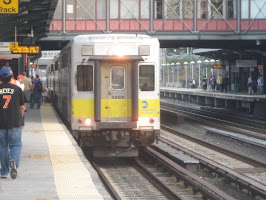
For the majority of LIRR riders, at least those in electrified territory, the train that comes rolling into the station each morning. You peer off the platform, and most of the time, a train made of M7 equipment rolls in. That is fair, as the M7 easily represents the largest portion of the fleet, with 836 of them rolling around electric territory. For the most part, the majority of trains are run by M7 equipment, however, every now and then, commuters will get a pleasant surprise and get an M9, or get an unpleasant surprise with a Budd M3s. 

M3s coming into Syosset (Photo: The LIRR Today)
The M3s a dying breed, currently represent a very small portion of the RR’s fleet. That’s bad considering the equipment coordinator will avoid these cars due to their age and reliability. The thing is, you either love their old nostaglic 80s retro design that gives you a blast to the past, or you hate the reality which is beaten-up, held together only by duct-tape.

Recently, the LIRR has finished rolling in the "M3 replacements", the M9s. You may ask why these cars are still in service, well that’s because the LIRR still needs extra capacity after East Side Access opened. These cars are expected to remain in service for another 3 or so years, as the MTA is funding additional replacements to get the last of these cars out of service.

In the rare cases where an M3 would quietly slither into a station, you would normally hear a couple of mumbled annoyances and sighs from commuters. Many people (especially commuters) do not like M3s, and it’s hard to blame them. These cars are from the 1980s, are aging, and did not go through a fancy mid-life overhaul like their Metro-North counterparts did. I mean, for many regular passengers, it’s not a nice surprise to see cars that are dirty and don’t gleam in the sun like the M9s or M7s. 

While I (and most commuters) wouldn’t call the M3s our favorites, there are also some unseen advantages to this equipment. To start, they feature more seats then the M7s, when they were first introduced, a two-car pair could fit 234 passengers seated, and a twelve-car set could seat 1,404 passengers, compared to the M7s which can only seat 1,266 passengers, a mere 138 less!

Now, this may not seem like a lot of extra capacity, but, when it’s rush hour, every seat counts and an extra 137 seats can mean the difference between people sitting or standing. The MTA knows that and they try to assign the M3s to the busiest rush hour trains; however, as these trains age even more, it’s become more difficult to rely on these cars.

If you’re a railfan or even just a normal passenger yet you're dying to some M3 action before they are gone for good, they are very commonly placed on the Jamaica - Atlantic Terminal shuttles during weekdays. They also make some appearances on rush hour trains, like #1515, the 6:44 AM from Huntington to Penn, where I’ve seen it multiple times and they normally are assigned to at least 1 PM rush hour run to Ronkonkoma, however, recently, it's been getting more sparse where. I've noticed in the last month or so they've been running more 12 car sets of them around, and while they still make up a shadow of their former fleet numbers, they are starting to return them to service slowly now that they have the excuse that the new M9As are on the way. During off-peak hours, apart from the Atlantic shuttle, it’s pretty rare to see them, only for equipment moves or passenger extras, they’re normally in yards during those times. They aren't normally found on weekends though. 


The M3s also aren’t really capable of going on the West Hempstead branch due to the substation near Malverne having issues with dealing with excess amperage, meaning that if they exceed P1 on the throttle, in either direction, the fuses will overload and blow up, causing the M3s and/or third rail to shut off. This makes it especially rare to catch them here.

Now I also recommend checking out Metro-North, which while doesn’t use them that much, it’s much easier to find them their then it is on the LIRR. To be honest with you, I haven’t been on the M3s too many times in my life, so they definitely don’t compare with the M7 or M9s for me, but I do like them and it will be sad to see them go.

Whether you're a railfan that enjoys them or a commuter that loathes them, the last of their replacements are on the way, so I recommend that you enjoy them before the Budd Metropolitans are gone for good.
Monday, May 26, 2025

Could More Dual Modes Be A Suitable Substitute For Electrification?

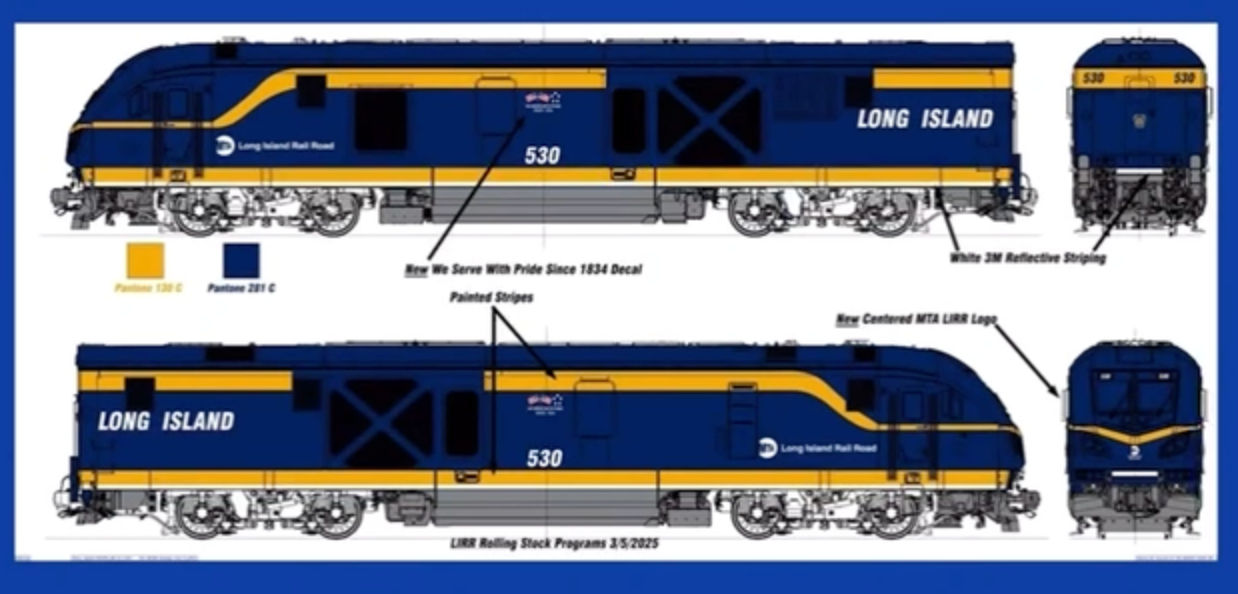
In today's post, I'm going to build on yesterday's post about the Crippling State of the LIRR's Diesel Fleet, by talking more about the future of the LIRR's current diesel fleet.

In the LIRR's most recent 20-year needs assessment (which will soon be getting a post of it's own), the LIRR didn't mention anything about electrification out to Port Jefferson or Patchogue, hinting this is not coming in the next 10 or so years. They did say that they'd analyze it in the 2025-2029 capital program, suggesting it's coming.

While it wasn't mentioned in the 20-year needs assessment, the LIRR once again, for like the third capital program, did mention possible future electrification of the Main Line to Yaphank, along with capacity improvements on the Port Jefferson and Montauk branches. It seams, at least for now, that given the order of up to 66 new locomotives, they're going down the dual-mode route. Even if they weren't to electrify the Main Line to Yaphank, 66 new locomotives would be more than enough equipment to cover service on the Port Jefferson Branch, Montauk Branch, Oyster Bay Branch, and Main Line east of Ronkonkoma. They may also have enough equipment to use it as a supplement to MUs on busy trains on other electrified lines, such as an 8-car MLV set covering a busy westbound Babylon Branch train in the morning, for example.

I believe the LIRR made the right choice with replacement of it's diesel fleet. They bought enough of them to provide a comfortable level of service, where they don't have to worry about not having enough equipment, something they constantly have to deal with now, and they have a little "wiggle room" to expand. I mean, look, it's better to have extra diesels around, which could be used to supplement electric trains during events, or provide emergency service during after major catastrophes (think Long Beach after Hurricane Sandy), then to have too few when electrification projects fall through. 

I'd much rather have a couple of extras lying around, which I guarantee you they can somehow find a way to use, and even if they can't they can always lease them. Some have voice concerns about ordering too many, and then it would "come back to bite them" if they do manage to finish any electrification projects during that timeframe. To me, this is very shortsighted as given the MTA's current track record of getting things done, they typically set a release date and it typically goes over that, sometimes by even a third or half. If they are planning to electrify, then they'll have 25 years before these new locomotives are due for replacement, to finish the job. 

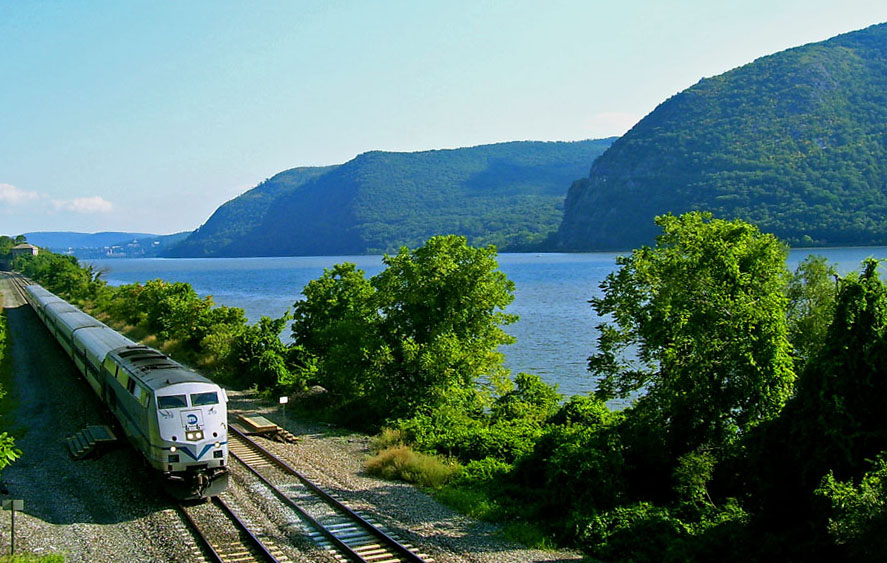
At this point, I think the LIRR should focus on improving service with the current fleet they've got and is getting. While electrification has and probably always will be the ideal option, as it allows for the lowest operating costs, direct service to all terminals, I believe if they truly make the best possible use out of the diesel equipment they have, then they could provide a level of service comparable to the average electric line.  Look at Metro-North, for example, which provides hourly dual-mode service to/from Poughkeepsie (besides the last train of the night from Croton-Harmon.) Those trains are constantly the most popular in the entire system, and are even more travelled than the electric trains are. If the LIRR were to adopt a similar system, they could possibly be even more successful.

I believe the main reason diesel service is so unattractive is because of the gaps. Frequencies are generally fine right now, and if they were to electrify to Patchogue and Port Jefferson, or provide dual-mode service, then they could probably provide hourly service to Port Jefferson and service every 30 minutes to Patchogue. While I believe hourly service is enough for my home section of the Montauk Branch west of Patchogue, if they were to electrify, they'd probably have to provide 30 minutes as a compensation for taking land. Plus they love to spoil this area anyway, so if there gonna electrify, you might as well let them do it. It would bring a lot to my area to have half-hourly service to points west.

Dual-Mode Fever

The massive order of 66 locomotives is more than enough to provide a baseline of hourly service from Patchogue, Oyster Bay, and Port Jefferson direct into Penn Station during pretty much all hours of the day, along with even better peak service than what is provided today. I'd say the biggest improvements would be on the East End, where they could close some of the largest gaps in service and provide more peak options. Look at Metro-North, which, like I mentioned above, provides a baseline of hourly-service to/from Poughkeepsie; that could represent service levels of Port Jefferson and Patchogue. Meanwhile, Danbury would do a great job representing Speonk and Oyster Bay (with roughly bi-hourly to/from HPA), Waterbury would represent the North Fork (with mainly shuttles to Ronkonkoma, possibly with the added bonus of a thru-train every once in a while), and Wassiac would represent service levels on the South Fork. Not only does Metro-North have considerable success with it's dual-mode operations, but, NJTransit's dual-modes are also doing a pretty good job.

If they are so popular, you may be wondering why the LIRR doesn't provide more dual-mode service now. I mean they have the equipment for it, and the demand, don't they? Well, the main reason they limit it is because they really don't have enough equipment to do so, and now that they'll have more equipment, this issue will finally be resolved.

I think the LIRR's main goal with buying these locomotives is mainly not only to expand their diesel fleet, but also to buy time to stall on electrification. Like I mentioned earlier, electrification should be the ultimate reward for these communities, as it provides a level of service that can't be seen using dual-modes, period, if the LIRR does a "free trial" using the dual-modes for 10-15 years, people of the communities in diesel territory will begin to realize the benefits, and possibly be more open to electrification.

In conclusion, yes, if the LIRR actually steps up and decides to make use of the new dual-mode locomotives to provide much-wanted dual-mode service, then, I strongly believe dual-mode service could supplement electrification, at least for a little while. 

Included below is a poll. Considering it's going to be another 20-25 years or so before these new coming locomotives are replaced, I'd love to know your opinion on how far you think the LIRR will have electrified it's system by the time 2045 rolls around:

Sunday, May 04, 2025

What Happened to the C1's?

For those of us (myself proudly included) who live out in LIRR diesel territory have heard of the C3s- (or even better have not just heard of them) the LIRR’s cool-looking bi-level coaches that get pulled by diesel engines.

But what few know is that the C3s actually had a predecessor- the C1s. The C1s were prototype cars built by Kawasaki for the LIRR to tour around the railroad to show off these new, futuristic systems and amenities to see if it appealed to passengers and to see if it would “work” on the LIRR.

To be honest, the C1s were basically just a scaled-back version of the C3s. They had the same basic general design, and the same basic features, with the C3 just including a more full “suite of amenities.” The LIRR and Kawasaki basically just collected input from passengers to create the trains we now call the C3s. They only built them for testing purposes and not to stay in the fleet, explaining why only 10 were built. Time for a fun fact? Did you know that the FRA changed it’s definition in the book therefore the way that some C1s were coupled would be considered a “married pair”, similar to what we see on the M3s, M7s, and M9s, therefore technically there were 5 sets of C1s roaming around!

Here are a couple of videos for if you’d like to see these cars when they were in service:


When the LIRR made one of it’s best decisions to purchase the beloved C3s, the C1s became the oddballs of the fleet with no real purpose. They could only be pulled by certain modified engines, and to add insult to the injury, they couldn’t even be paired up with the C3s. And why weren’t they you may ask? They’re literally supposed to be very similar cars? Well, it’s the LIRR and who knows why. The C1s had different couplers and the C1s couplers proved to be a big limiting factor for those cars. The C1s couplers were actually quite similar to those found on the M1s and M3s, however, they obviously couldn’t be coupled to them as those were MU cars and these were powerless coaches and they couldn’t be coupled to C3s (or their engines for that matter) as the C3s had more conventional couplers and the C1s had 27-point jumpers (like just about every other railroad in the world), meanwhile the C3s had 36-point jumpers, a very odd choice. The C1s were also known to be a pain maintenance-wise requiring heavy maintenance and being a pain to maintain.

So, in the end, it would’ve cost much more to retrofit these cars for service with the other cars then it would to just buy 10 more C3s, therefore the LIRR chose the sad but much more logical decision. While the C1s had a short life, it was a fulfilling one and as a matter of fact, the C1s were also the first cars to get to experience dual-mode technology as they were the first cars to run on the LIRR’s new dual-mode train from Port Jefferson to Penn Station on weekday and as you can guess, people really took a liking for these 1 seat rides as we now have 11 of them per weekday!

(Photo: s2vAA777 on YouTube)

But whatever happened to the C1s?

When the LIRR was through with the C1s, they sat collecting dust for a while before being sold elsewhere to various heritage railways.

These C1s belonged to the Saratoga & North Creek Heritage Railway in Upstate NY which as of July 2018, sadly closed its doors. 


These C1s have been found on the Rio Grande Senic Railroad, however I can’t tell whether or not those cars are still there.


And if you'd like to actually board the C1s, the Cape Cod Central Rail Road also has some in service and as a added bonus, they are pulled by FL9's as they were in LIRR service.


And, I may even be visting Cape Cod Central Railway this Winter to ride the Polar Express train and experience these cars for myself, something I never got to experience before.

If you’d like to see more photos of this train, there’s a website with them. 

In conclusion, the C1s will always hold a special place in my heart for being the prototype to my favorite railcars. 

Friday, December 20, 2024

'Middleseatphobia'

There it is… the little seat that couldn’t. The dreaded middle seat. Walk down just about every single train, rush hour or not, tons of standees, or no standees, and you’ll see just about every seat but the middle seat filled.

Photo: MTA LIRR

If your most people, like me, you’ll have no problem sitting in the end seat (not that the window seat isn’t much better, but also not that it matters since you can’t see out the window!), but if asked to stand or sit in the middle seat, most people will choose to stand. If you sit in this dreaded seat, your squished in between two other people, have no armrests, and if one of the people next to you is smelly, loud, et cetera, then it could mean a hell of a ride for you.

On the LIRR & MNR, the middle seat is only on the MU equipment (M7s, M8s, M9s), as it’s a 3-2 seating arrangement,  and on the Shoreliners and C3 equipment, the bodies are narrower so they can only fit four seats per row. 

The main reason for these seats is because of ADA requirements. Because of all the ADA required things for accessible riders, which is a very good thing, but also means that they have a significant reduction in seating capacity meaning they had to include the middle seat.

An almost (or more) uncomfortable seat is the facing seats, for the reason of it being impractical to have all seats per car facing the same way as some prefer to sit one way versus the other, and therefore they have to meet somewhere in the middle of the car. However, these seats are annoying because their very cramped and the legroom is abysmal.

Photo: The LIRR Today

What makes this whole “Middle seat” situation even worse is when the LIRR calculates ridership numbers, and more importantly, standee numbers, they calculate loading percentages, assuming that every seat (including the middle seat is filled). So for the vast majority of the LIRR & MNR’s rush hour trains, the standee counts are all screwed up and because of this, the LIRR thinks it’s fine to run less then 12 cars on those trains and everyone will allegedly have a seat.

But the truth is, walk down any rush-hour train, and chances are, only a couple of middle-seats in an entire 12 car consist will actually be filled. I think to help fix this issue, the LIRR should only factor window seats and end seats into their calculations, maybe including one or two middle seats per pair. Because the number of “end seats” and “window seats” tallys up to 144 seats per M7 pair, and that number excludes the 51 middle or facing seats that people will avoid, and the 16 fold-down seats that also are avoided (though not in as high contempt as the middle seats)

As it turns out, ‘Middleseatphobia’ (or whatever you’d prefer to call it) is a real thing among LIRR & MNR commuters, and the fact that people would rather stand then sit their pretty much proves my point. In a perfect world, the LIRR & MNR would try to base their equipment rotations and loading factors better on the seats that are actually used, not just the ones that exist.

Also, before I go, happy last day of work or classes before the holidays!