Next up is the Montauk Branch. I decided to do this one today, because Sunday is well, my birthday, and today is well the last day of school before my birthday so why not do such a special post on such a special day! Anyways, we’ve now entered uncharted territory. Up until now, we’ve mainly been covering branches with rather simple service patterns and simple peak service, but today, ladies and gentlemen, we’ll dive into the rather complex Montauk Branch! Weekday service is complicated enough, but once you throw in seasonal service, things start to become extremely difficult.
It’s often overlooked, but the Long Island Rail Road’s Montauk Branch sees quite a few riders along its length, especially during the summer. The branch is known for its summer services, and the famous “Cannonball” that runs nonstop from New York’s Penn Station all the way out to the Hamptons and Montauk. Ridership has been growing, especially along the segment between Babylon and Patchogue, but also out in The Hamptons and Montauk. Even Mastic-Shirley and Speonk, despite service challenges, are slowly growing. The achilles heal of the branch is on Summer Sundays when the LIRR can’t keep up with the extreme demand being put on the Summer Hamptons trains causing extreme crowding and delays. My hope is that the LIRR will continue to adjust the schedule until they finally get it right. I’ve definitely made many changes to how the Summer Sunday service is run in an effort to even the loads and shift service a bit.
As you may or may not know through my various posts overtime or by knowing me, my home branch is the Montauk Branch and I ride it relatively frequently. I’m very familiar with it and therefore, I believe I’m able to help it even more and I’ve put in “extra effort” in an attempt to really try to get it right and excuse me if I go a little “over” with service on this branch.
One of the most important observations I’ve noticed is the increase in intra-island travel. In general, the further east you go, the less and less people who will actually go as far as Manhattan. People in the Hamptons and Montauk are tired of trekking all the way to the city all day, therefore, they seek jobs in locations in Suffolk or even Nassau Counties. However, since train times to their jobs aren’t favorable, they just drive instead. The introduction of the South Fork Commuter Connection (SFCC) definitely made a difference, but there’s still more to be done with both LIRR and SFCC service out there. My timetables specifically pay extra attention to intra-island travelers, as there’s so much room for growth in that department especially on this branch, and I did my best to make sure they were well looked after.
In general, my sample Montauk Branch timetable represents a noticeable increase in trains, especially during the reverse and off-peak periods. However, this also represents a smarter use of equipment. A good example of this is balancing the amount of trains to Montauk. The timetables below show sample service patterns for weekday and weekend Montauk Branch service, east of Babylon. It’s important to note that at this time, connecting trains aren’t shown, and they may or may not be once all the timetables have been created and published.
Included in the linked PDF file below is full Sample Weekday and Weekend Montauk Branch Timetable. Peak, off-peak, extra, and special event trains are all included. Note that this is a new and improved timetable design.
The timetables have yet to include deadhead/non-revenue moves, which will be planned out using AI to align with crew and equipment moves and will be written down on paper. They’ll be included on a separate page in the attached PDF. I tried to mostly minimize deadheading as it’s essentially wasted time, crew, and equipment hours but in some cases it’s unavoidable to make the most out of the resources available.
Before we can dive into the actual excel timetables, let’s quickly go over Key Assumptions and Service Guidelines:
Key Assumptions
- The current infrastructure on the branch will remain the same or similar to what it is today.
Service Guidelines
- Rush hour service should be increased to meet current ridership demands, especially in The Hamptons and on the Babylon - Patchogue segment.
- During the morning rush hour, service mainly consists of a mix of trains out of Speonk and Patchogue. Trains from Speonk and Mastic-Shirley typically originate out of Speonk Yard while trains from Patchogue usually turn off eastbound trains at Patchogue. Service definitely resembles what’s currently on the timetable, but there’s the addition of more trains. The branch keeps the current westbound dual-modes with both following the same schedule as today. Two trains originate out of Montauk in the morning rush to match the two that terminate there in the evening rush. In addition, I was able to schedule an additional early-morning run out of Patchogue.
- Service during the evening rush hour is much less structured (not that it is during the morning rush) but I think I did a good job of balancing equipment over the course of the rush hour. The two current dual-modes in the evening run on the same schedule as currently and I’ve introduced new trains to fill in the various gaps over the course of the rush hour, and most of those trains leave from Hunterspoint Avenue/LIC or Jamaica.
- An important thing to note that SFCC Services/East End Scoots have not been included. Those will be included in the South Fork timetable which will come out in a couple of months once I’ve made it.
- During the midday off-peak period, hourly service at a minimum has been sustained to Patchogue, and while much more “wild” I was able to give Speonk and Mastic-Shirley a rough average of bi-hourly service. This meets the current service standards as far as Patchogue, and there’s a huge improvement in midday service to Speonk. There’s currently some very nasty gaps including a large gap during the entire morning between 7:14am and 12:46pm, and I was able to completely eradicate that.
- Another addition is expanded reverse-peak service. Currently, during the mornings, there’s a 2 hour gap between trains to Patchogue and I was able to lessen that gap by exactly an hour with the inclusion of a brand-new reverse-peak train to Speonk for the first time ever! Trains that would otherwise be equipment trains will now accept passengers along their way. For example, there are now several “revenue deadheads” out of Jamaica Storage Yard in the early morning hours, and I had these trains make stops along the Mainline or Babylon Branch to supplement service there too. Westbound reverse-peak service in the afternoon has also been improved, esspecially along my home section with trips being added from Sayville, Patchogue, and Speonk.
- On weekends, hourly service has been sustained at a minimum to Patchogue and bi-hourly to Speonk. I’ve also added additional trains during the busier weekend periods in the morning going westbound and in the evening going eastbound, especially by completely eradicating the ridiculous two-hour 6 minute gap along the Patchogue-Babylon segment. I will discuss Summer Hamptons service below.
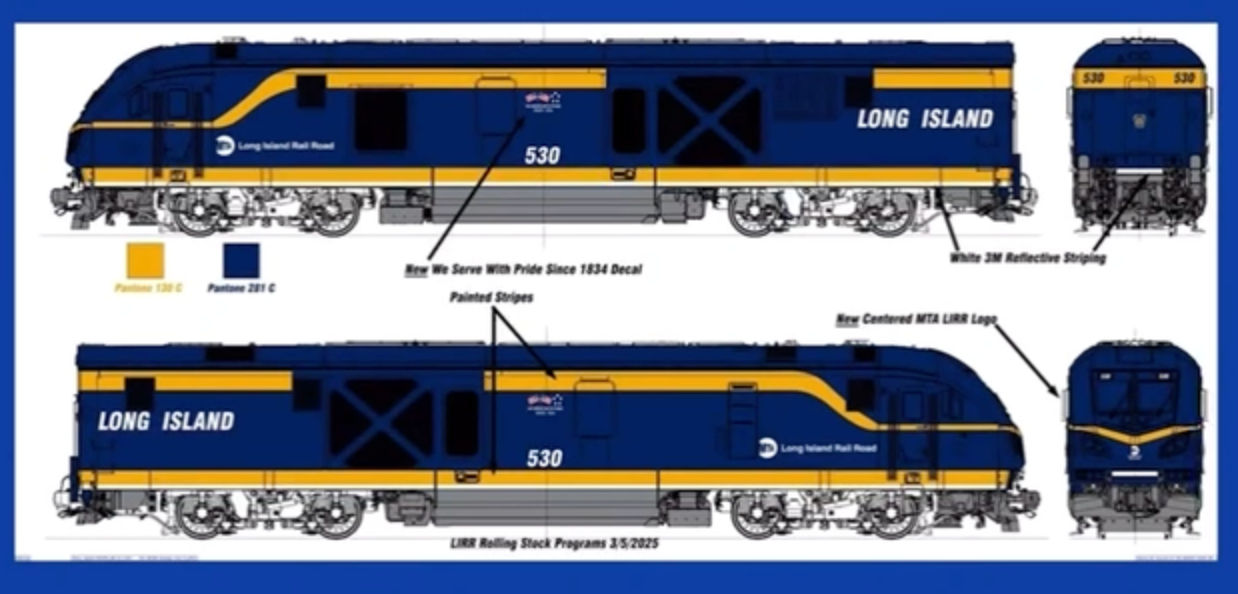
To start, we need to note that the LIRR has very limited diesel equipment. Therefore, it was difficult to provide good service on the diesel branches. The current fleet is in no way capable by any means of handling the overwhelming ridership, especially during the Summer, and with the current equipment, there’s little room for growth. That being said, I’ve written these timetables with the intent of them being utilized by current equipment. Luckily and also sadly (Railfan part of me), the LIRR has ordered more equipment so I will do my best to provide even better service once they come.
On the weekday westbound panel, a new early morning train has been added out of Patchogue, therefore closing the 50 minute gap between the 4:47 and 5:37am, as commutes are growing earlier.
Morning peak service is structured similar as it is today, and many of the morning rush hour favorites have resumed similar or the same schedules as their real-life counterparts. Most of the through-trains on the branch terminate at Hunterspoint Avenue or Long Island City, however, the first through-train from Patchogue terminates at Jamaica for better use of equipment (train #51 turns in Jamaica to make up the first morning departure to Oyster Bay.) The first dual-mode train which is out of Southampton continues to follow its schedule, while the other dual-mode from Speonk also continues to depart Speonk at 6:18am. Currently, there’s only one morning train from Montauk. One of the biggest additions to this timetable is the addition of a new express DM from Montauk at 4:37am. This train makes all stops to Speonk, then runs express from Speonk to Patchogue, before running nonstop to Jamaica, all the while doing this in as little time as humanely possible. This train provides an earlier departure from Montauk, something I’d desperately like to see, while providing an express run and getting people in in city in time for 8am jobs. This train runs ahead of my favorite train, train #37, therefore, people who need the local stops can just drop-back at either Speonk or Patchogue.
I’ve done my very best to built up service on the branch in hopes of drawing riders of the busy Ronkonkoma trains, and by increasing Montauk Branch service, during the peak of the peak, especially west of Patchogue, I hope to make the Montauk Branch a much more attractive option. Currently, there’s a large westbound gap between 6:56am and 7:35am on the Patchogue-Babylon section, therefore you can get to New York at 8:18am or 8:52am. I personally think this is very annoying that they don’t run another train in between, therefore, I’ve added in an additional train in departing Southampton at 6:11am at to eliminate that gap and provide another train during the peak-of-the-peak that I think is perfectly timed and I think this will be worthwhile in getting people to stop driving from communities along the Montauk Branch up to Mainline stations since Montauk Branch service stinks compared to what they can get at Ronkonkoma, for example.
During the morning rush, there’s a funny-looking train I think I better mention, train #57. This train originates in Patchogue and closely follows the same schedule as its counterpart as far as Babylon, however, instead of terminating in Babylon, it continues up the Central Branch, making all local stops on the Main Line between Bethpage and Floral Park, before going to Belmont Park via the eye there. While this train isn’t perfectly timed for the average intra-island traveller, this train is perfectly timed for people who need to get to Nassau County earlier, such as teachers or construction workers. This train is perfectly timed to encourage intra-island travel to places on Long Island such as Bethpage, Westbury, Floral Park, and Belmont, while also providing additional opportunities for Hicksville and Mineola. I had this train run to Belmont Park so it doesn’t get overrun with by making all the local stops from Patchogue to Floral Park. Manhattan commuters, however, aren’t left-out as they can transfer at Babylon to an electric express train to Grand Central. My hope for this train is to encourage intra-island travel along the South Shore. The equipment would then turn for to become #1823 from Belmont Park to Long Island City where it would be mixed back into the diesel pool, therefore it would be theoretically possible to ride the train all the way to the city if you wanted to go all the way out of your way!
One of the most beautiful things of this timetable is the improved service east of Speonk. 2 new westbound trains #13 and #19, departing Montauk at 9:30am and 6:23pm have been added to the schedule along with the dual-mode. All 3 of these trains fill huge gaps left by other trains, and coupled with the South Fork Scoots, will really help encourage midday travel on the East End. I’ve also added many more trains to/from places in the Hamptons such as East Hampton, Bridgehampton, and Southhampton, and especially during Rush and reverse-peak hours, these really help make the frequencies east of Speonk attractive.
Midday service on The Montauk Branch is mainly comprised of typical hourly-scoots to Patchogue, along with the occasional Speonk train, however, additional westbound trains have been added throughout the day from Mastic-Shirley and Speonk to encourage ridership. In addition, there’s a new weekday off-peak eastbound train from Jamaica to Southampton. One thing you’ll notice as a trend through this timetable project is that there’s many more off-peak and reverse-peak trains start/end in Hunterspoint Avenue or Long Island City, I believe that with the development going on in the area, there’s definitely room to grow and I also believe it’s much easier to just turn trains there. I’ve tried to convert all trains that run empty equipment moves there over to revenue runs, and I’ve sent additional trains to turn there as well as an alternative to Oyster Bay service. Certain off-peak trains add stops at Hicksville and Mineola and this was done specifically to supplement service there.
To give a word on weekday reverse-peak service, there are a number of “revenue deadheads” that will start out of Jamaica Storage Yard early in the morning in order to get equipment out to Speonk and Patchogue to makeup westbound runs. These trains will make additional stops along the Babylon Branch or Mainline to supplement service there, too.
The weekday eastbound timetable includes most of the current eastbound runs, however, several trains have been eliminated and repurposed to provide better service. I’ve been able to add additional trains into the excel timetable, especially during the peak-
Weekend service mainly resembles current weekend service, however, additional trains have been added to the schedule during the busier weekend periods (specifically 8:30am WB to 11:30am WB and 4:00pm EB to 7:30pm EB). One additional train has been added out of Montauk on weekends leaving Montauk at 9:23am in hopes of eradicating that nasty gap between 7:01am and 3:16pm during the winter, and to take some load off of #6005 in the summer. A new early-bird fisherman’s train departs Hunterspoint Avenue at 5:00am sharp on summer weekends, allowing travelers to maximize their time out on the East End. In addition, multiple additional eastbound trains have been added to the schedule in order to provide additional weekend East End travel opportunities all year long. Additionally, two eastbound trains have actually been fitted it in the afternoons, to patch the unacceptable 7 hour gap in eastbound service out there.
Once we slither over to the weekend westbound panel, we notice that all of the Summer Sunday Hamptons trains pretty much take over the timetables. Be sure to read the reference notes in the columns carefully in order to determine which trains run on which days!
From my observations on how the Montauk Branch survives functions during weekends in the summer, the vast majority of delays are first caused by slow loading. These delays are some of the worst type of delays as they can quickly amplify into huge delays that we therefore have to suffer through the entire afternoon. What happens is, the platforms at stations in the Hamptons are short, therefore, trains have to spend lots of time taking on passengers at every stop and while the train may have enough cars to accommodate the loads (rarely), the short platforms slow things down CONSIDERABLY! If a train has to sit there for a couple of extra minutes at each stop, that time can add up to 20 minutes by the time you finally reach Speonk. Minor delays can throw off even the most heavily padded of them all, and one late train (#6005 I’m looking at you!) can put a chokehold on the entire branch.
Summer Sundays are some of the worst days to ride this branch as trains OTP’s are atrocious, and while I wish I could say I had a solution, I really don’t. There’s really not much I can do to help things, you see, the LIRR is an extremely capacity-restricted system, and there’s not enough equipment to provide the level of service needed on these days. I tried to patch the worst of the gaps, but the most I could do was add a train here or there from Southampton, to hopefully dull some of the loads, but most of the loads are from stations east of here anyway.
One thing you may notice is the addition of a couple of Patchogue-Hicksville scoots on summer weekends. As we know, the most of the crowding and lateness comes from the East End, however, there's also crowding at stations such as my home station of Sayville for people going to the fire island ferries. These trains are timed to run before the their typical counterparts to provide additional options in hopes of reducing crowding.
I’ve noticed that the trains that typically rack up the worst of the crowds are trains 6001 (the 7:01a from Montauk to Jamaica), 6005 (the 11:37a from Montauk to Jamaica) and 6007 (the 1:47p from Montauk to Jamaica). If you know the schedules, you may notice a trend, all 3 of these trains have huge gaps accompanying and preceding them. #6005 is easily the worst of these problems as it’s so popular due to the fact that there’s a 4-hour+ gap before it. Therefore, it constantly runs extremely late due to overcrowding and during the worst summer weekends gets extended to Penn Station since it typically runs with dual-mode equipment and because there really isn’t room on any poor connection to be bombarded with 12 cars worth of people! I’ve decided to just extend it to Penn Station since it obviously goes there normally anyway.
One thing I’ve done is add Hicksville and Mineola stops to some Montauk, Speonk and Southampton trains in both directions, allowing for Nassau County residents to more easily get out to Fire Island and the East End more easily.
The Cannonball and its westbound counterpart, The Cannonball West both run on the same schedule as they currently do, and many other famous Hamptons trains continue their legacy. In the future once I dive even deeper into East End Service Patterns, I hope to bring back famous named-trains such “The Sunrise Special”, “The South Shore Express”, “The Montauk Special”, and “The Patchogue Express”!
I also want to quickly touch upon the brand-new train 6008. Currently, the current 6008 is an all-year train to Montauk, leaving Jamaica at 8:13am, and is the most popular of the weekend Jamaica-Montauk trains. However, in my schedule, that will run on it's same schedule, but under #6010 to make room for the new #6008, a 7:14am express from Penn Station to Montauk. This new train will depart New York at 7:14am, stop at Jamaica before running non-stop to Patchogue, Speonk, and all stops to Montauk. This train runs unsettlingly close to train #6006, however, on Summer Saturdays, it provides a one-seat ride and much needed capacity. I originally planned to include Bay Shore and Sayville stops on this trains to provide a one-seat to the fire-island ferries, however, I decided by doing that that would get rid of the "express" nature I wanted for this train. In addition, later on in the afternoon, I added an a
In conclusion, I think I’ve given a good run-down on the major points of these service patterns. You’ll definitely notice oddities in this schedule, and I almost always have explanations for them, so if you’re interested in more elaboration, please don’t hesitate to leave a comment. It's a huge branch and time did not permit me to cover nearly close to all the material there was to cover. It's way more likely then not that I made a mistake, especially with the single-track east of Sayville, and if you catch any mistakes please let me know. As always, if you have any comments, thoughts, suggestions, corrections, etc, you can leave a comment below.
View an index of all the other sample timetables, the post about those timetables, and revision history, right here.

.jpg)